Sunday, April 16, 2017
20 Time Project with Java Post 3
I have had multiple discoveries and setbacks in my 20 Time Project. I have finished my program that uses DFS to compute the shortest distance from one point to another. Now I am working on the program that uses BFS to do the same thing, and after that, I will use dynamic programming (or some other algorithm) to so the same thing again. Some setbacks were that it was kind of hard to program in Java since I am more used to the C++ syntax. I plan to handle this setback by being more organized when I am programming. One discovery is that the two languages are not too different, so it isn't too hard to go between the two. I have gradually regained my memory on how to use Java. I can apply this to myself by finding the shortest path form one place to another.

Friday, April 7, 2017
Unit 8 Reflection
Include 2 photos/videos
This unit was about evolution. We learned about Darwin and what he did with evolution. He sailed around the world in his H.M.S. Beagle and discovered many interesting things, such as finches with many different types of characteristics on the Galapagos Islands. He found that populations, and not individuals, evolved through natural selection. This was when a group of organisms with variation have different levels of fitness, making the more fit organisms more able to survive and reproduce, changing the gene pool of the population. There also can be gene flow, changing the gene pool through ways such as immigration and emigration. Also, we learned about different types of evolution, such as directional selection (ex: Hunger Games Lab) where organisms evolved towards one direction, stabilizing selection where organisms evolved toward the middle, and disruptive selection where organisms evolved toward the two extremes. Artificial selection was the results when humans chose the traits they wanted. We studied different causes of speciation, including behavioral isolation where two species had different behaviors, geographic isolation where two species where separated by a geographic feature, and temporal isolation, where two species have different times for mating. We also discovered different ways of how we could tell that organisms descended from a common ancestor. These ways included embryology, where scientists found that many species with common ancestors had similar embryos. Another way to tell ancestry was vestigial structures, structures used by the ancestors of certain species but not used by the current species. Fossils were also used to show how organisms evolved throughout the years.
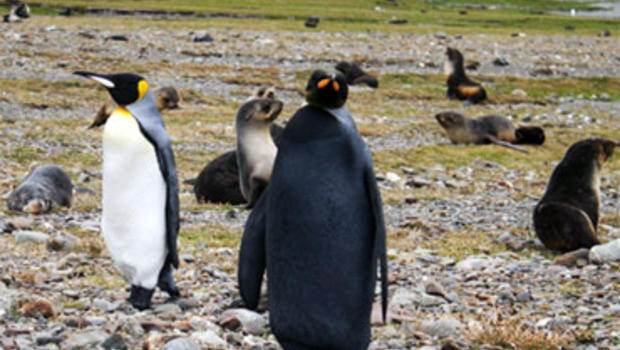
I would like to learn more about how life began to exist. I have an unanswered question of how Darwin actually noticed that all the birds from the Galapagos Islands were related finches, and that they came from the South American mainland. I wonder about what would happen if a lot of the penguin population turned into black penguins.
Since the Unit 7 Reflection, I have said what I wanted more and had more eye contact in my conversations, to be more assertive. To be even more assertive, I need to stand up straighter and "fake it 'till I make it."
This unit was about evolution. We learned about Darwin and what he did with evolution. He sailed around the world in his H.M.S. Beagle and discovered many interesting things, such as finches with many different types of characteristics on the Galapagos Islands. He found that populations, and not individuals, evolved through natural selection. This was when a group of organisms with variation have different levels of fitness, making the more fit organisms more able to survive and reproduce, changing the gene pool of the population. There also can be gene flow, changing the gene pool through ways such as immigration and emigration. Also, we learned about different types of evolution, such as directional selection (ex: Hunger Games Lab) where organisms evolved towards one direction, stabilizing selection where organisms evolved toward the middle, and disruptive selection where organisms evolved toward the two extremes. Artificial selection was the results when humans chose the traits they wanted. We studied different causes of speciation, including behavioral isolation where two species had different behaviors, geographic isolation where two species where separated by a geographic feature, and temporal isolation, where two species have different times for mating. We also discovered different ways of how we could tell that organisms descended from a common ancestor. These ways included embryology, where scientists found that many species with common ancestors had similar embryos. Another way to tell ancestry was vestigial structures, structures used by the ancestors of certain species but not used by the current species. Fossils were also used to show how organisms evolved throughout the years.
 |
| Different types of selection |
 |
| Black Penguin |
Thursday, March 30, 2017
Hunger Games Lab
- In this lab, we experimented on how populations evolves and how allele frequency changes. In the start of the experiment, we had around equal amounts of the three types of birds, and allele frequencies. After a while, the stumpys died off, but eventually came back through the mating of knucklers. This simulates the process of directional selection, as the birds population consisted of more and more pinchers.
- The pinchers were the best at gathering food, because they could use their fingers to pick up food, which is what humans have the easiest time doing, instead of using knuckles or wrists.
- The population evolved, because it consisted of more pinchers than it did in the beginning. The "a" allele in the gene pool changes from around 50% to 5%.
- The process of mating was not random, because everyone wanted to produce more knucklers. The distribution of food was both random and not random. It was random, as the food was spread out evenly in terms of around the circle. It was not spread out evenly in terms of where the food was placed.
- If the food was larger, the stumpys would have a better time collecting food, and if they were smaller, then the stumpys would have a harder time collecting food. This would affect the survival of the stumpys and the gene pool. This might happen in nature, such as for birds, the beaks would evolve bigger to be able to pick up the big food better, or evolve smaller to be able to pick up the smaller food better.
- If there was not incomplete dominance, then the "A" allele would be a bigger part of the gene pool, as it wouldn't be selected against as much, as the "Aa" organisms would be pinchers.
- Natural selection can lead to evolution. Organisms with the traits that are selected against would die off, and the organisms with the traits that are selected for would prosper. The population would then evolve toward being more like the organisms with the food traits.
- Some people cheated, and used their hands in order to have a better chance of survival. Some stumpys scooped up their food to gather them more efficiently. This would have affected the allele frequency of the population to be more like the ones with more efficient gathering skills. This could happen in nature, if the more fierce and competitive organisms gathered food better.
- In evolution, the population, and not the individual organisms evolve. Natural selection acts on the phenotype, because the ones with more physical capability can survive better. One example of this is that if heterozygous organisms were pinchers, they would not have a disadvantage towards the homozygous pinchers, and therefore would not be selected against.
- What happens if the "A" allele dies out completely, and then nature selects against the "a" allele after all the "A" alleles are gone?

Allele Frequency Graph

Monday, March 20, 2017
20 Time Project with Java Post 2
There are many different algorithms in the programming language which can help facilitate the run time of a program, make the program easier to read, or have other benefits. I have been studying Java for the past few weeks, and I have been studying different algorithms with the traits as described above. I have been studying the method called Depth First Search (DFS), which I have already learned in C++, but I am learning to incorporate it into Java. I have some setbacks in mixing up the code for C++ and Java, so I sometimes get confused. The next steps for my 20 Time project is to finish learning about DFS and continue onto BFS. I can apply this to me because I like programming.
Tuesday, March 7, 2017
Unit 7 Reflection
This unit was about ecology basics. Some of the big ideas were interdependence in nature, and matter and energy. The first chapter in this unit is the biosphere. In this chapter we talked about the different types of interactions between species, as well as interdependence. We learned about how energy decreases on every trophic level, and how food webs help sustain populations. We learned about different types of cycles, such as the water cycle, and how it impacted people and other organisms. The next chapter is about ecosystems and communities. In this chapter, we talked about different ways that temperature can be changed, as well as biotic and abiotic factors, which are classified mainly by whether they are living or nonliving. There are several interactions between species, including predetation and symbiosis. Symbiosis also includes three subcategories, including mutualism, commesalism, and parasitism. Different types of succession are categorized based on whether the process started with or without soil. The species that start the primary successions are called pioneer species. Biomes are classified by their soil and climate, as well as the plants and animals found in it. Some of the major biomes are the tropical rain forest, desert, temperate grassland, tundra, and northwestern coniferous forest. The next chapter is about populations. We first talked about population growth. In the beginning, species usually go through an exponential growth. Later, when the population starts reaching the carrying capacity of the region, it goes through a more logistic growth curve. Limiting factors cause the population to decrease. Density-dependent factors are factors that are dependent on density, and density-independent factors are factors that are independent on density. These concepts are demonstrated pretty well in the human population growth patterns, also called demography. The next chapter is about humans in the biosphere. In this chapter, it talks about how humans affect the environment. People started to hunt and gather a long time ago. But some time after that, they learned how to grow their own stuff, agriculture. Then came industrial growth and urban development, which brings us to where we are today. There are many different types of resources, and we can classify them into groups such as renewable, nonrenewable, land, forest, fishery, air, and freshwater.
I'd like to learn more about the different types of biomes, and what types of things are included in them. I wonder about how people are taking over the world, and are approaching carrying capacity. The Conservational Biology Project went decently well. We all worked well together, although we had trouble getting together to record the video. I learned a lot about many different ways of how Madagascar was being threatened, which is also the part that I researched. In this unit, we also worked on 20 Time. We made our first blog posts, which can be found here. After taking the self assessment, I noticed that the numbers in all four categories were the same. Therefore, I do not have a dominant conflict style.
Monday, February 13, 2017
20 Time Project with Java Post 1
20% Time is one-fifth of your class time dedicated to following your passions and doing what you want to do. I allows students to explore themselves and make a project to demonstrate their skills. The essential question that I have asked is, "How can you use Java to make complex programs?" I chose my 20 Time project to be on learning some Java each session, and making a project using all that I learned.I chose this because I do not think I learned much in the AP CS class I took last year, and I would like to broaden my coding skills. My project will answer the essential question by creating some type of complex program. My goals are to learn more Java and be able to use those concepts in making something. I will measure myself on this project by seeing how much of the stuff I can remember. I will also test myself by making a project at the end. My plan moving forward is to learn something, practice something, and/or review something during each 20 Time session.
Tuesday, January 31, 2017
Unit 6 Reflection
This unit was about biotechnology. Biotechnology was about how people could manipulate biology to improve mankind. It is like technology in biology. But not all the new technology necessarily was ethically good. The new technology may lead to genetic segregation, such as the case of GATTACA. We learned about how to perform the process of gel electrophoresis. In this process, DNA are sorted by their lengths. We also learned about recombinant DNA, which was when DNA was borrowed from one organism to put in another organism. Bioethics is where people decide if something is correct to do, in the context of biology.
The unit went by fairly well. The "20 Time" was a big change, as it took up a lot of the class time. I got along with my new group well, as there were not much disagreements. This unit was a new topic to me. I had no experience of biotechnology before, so it was more interesting than the other units.
This unit, we did two labs, the Candy Electrophoresis Lab and the pGLO Lab. In the Candy Electrophoresis Lab, I learned how food coloring was used in foods, such as candies. I also learned how to "run a gel." In the pGLO Lab, I learned how different things can affect the growth of bacteria. I also learned about how plasmids could be used in organisms.
I'd like to learn more about the different things that biotechnology has impacted, such as cloning animals or artificial photosynthesis. The process of "20 Time" is kind of confusing. The ethics part is also kind of confusing, since it is sometimes very hard to decide whether something is good or not.
(See here for goals) For the goal related to biology, I have studied most of the days for the week or two after I made the goal, but I have slacked off recently. I should study more next semester to improve on the goal. For the non-biology related goal, I have transferred sports from track/ field to swimming. Therefore, I will try to make most of the swimming practices from now on.
Subscribe to:
Posts (Atom)